

WGSS Remembers A. Lynn Bolles
February 18, 2026
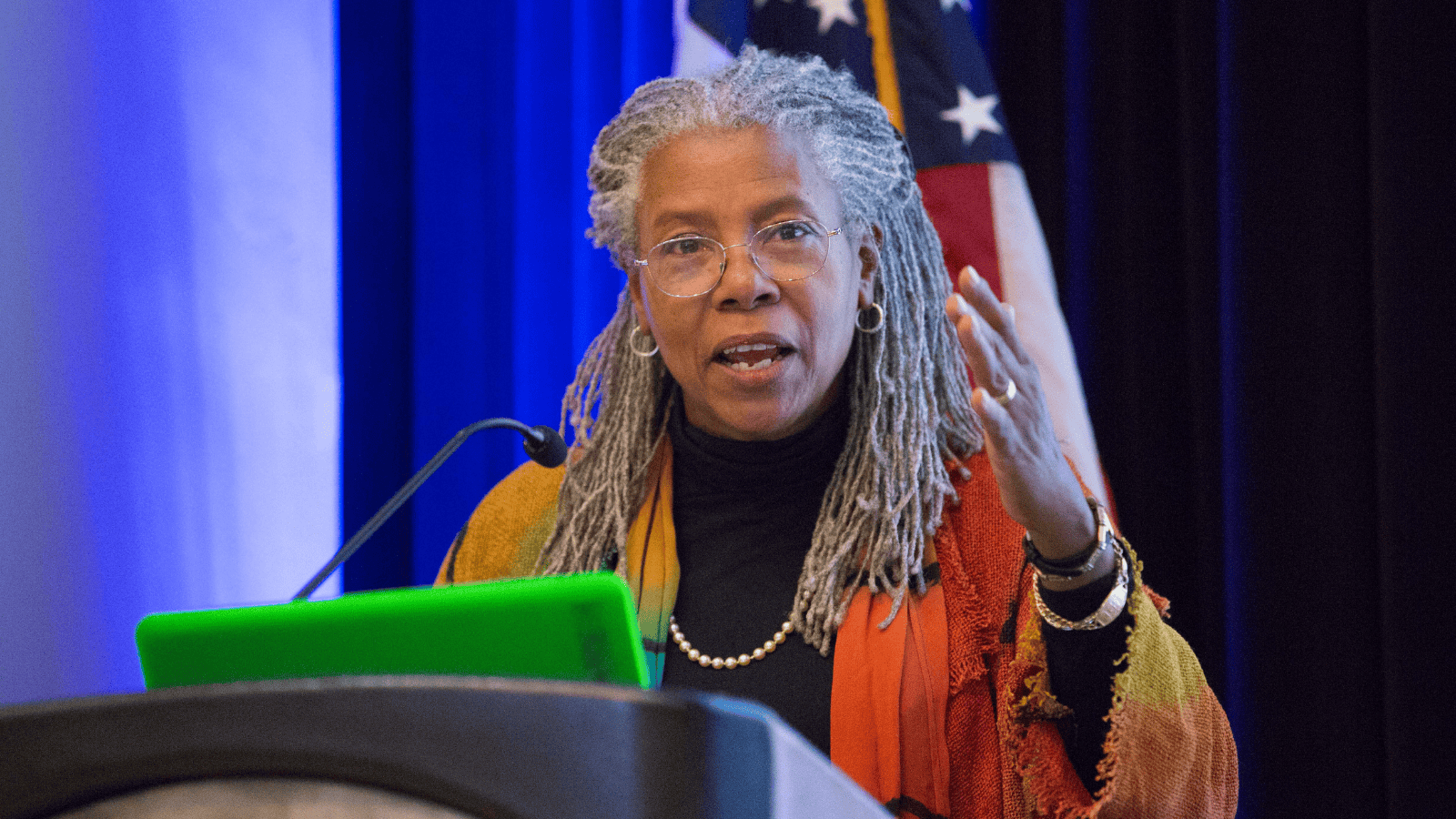
The WGSS community mourns the passing of respected anthropologist and cherished colleague Augusta Lynn Bolles
A. Lynn Bolles, Professor Emerita at the Harriet Tubman Department of Women, Gender, and Sexuality Studies at UMD, College Park, and a prominent scholar of women, organized labor, gender relations, and tourism in the Caribbean, Latin America, and the U.S., passed away on February 8, 2026, in Maryland. She was 76 years old.
Widely recognized as an important pioneer in women’s studies, Bolles was among a cadre of feminist scholars whose work helped build the field as it established itself and flourished in the Anglophone Caribbean. Dr. Bolles published three books with academic presses and many articles in a wide variety of edited volumes.
Lynn received her undergraduate degree from Syracuse University and her Ph.D. in Anthropology from Rutgers University, where she was mentored by Helen M. Icka Safa. Her life and work were supported by her beloved husband Jim Walsh, and later her sons, Shane and Robeson.
She joined the Women’s Studies Program at Maryland in 1989, after serving for eight years as the Director of Africana Studies and Associate Professor of Anthropology at Bowdoin College, where she left a strong legacy as one of the founders of the Gender and Women’s Studies Program. She served for many years as a member of the editorial collective of Feminist Studies (1988-Spring 1997), a leading journal in the field. Often nurturing the work of younger scholars, she was a valued and sought-after mentor for undergraduate and graduate students, and a generous colleague whose labor helped shape the contours of feminist studies and sustain them at the intellectual and institutional level.
Lynn Bolles is best known for her scholarship that tracked and unpacked the complexities of Caribbean women’s labor. Whether addressing Caribbean women’s work as trade unionists and leaders within the region’s vibrant labor movement, or the labor involved in the domestic sphere, the tourism economy, and other forms of communally based informal economies, Lynn was committed to showing the complexities of Caribbean women’s lived experiences.
Such was Lynn’s commitment to her field site that Rhoda Reddock, former deputy principal at The University of the West Indies, echoed many when she said, “I always wondered if Lynn had Caribbean links, but this was never confirmed. What was never in doubt was her interest and commitment to the region as a feminist anthropologist.”
Lynn centered her subjects. In her research and certainly, in every conference presentation, you left knowing that she had done the work of forging deep and genuine relationships with the members of her research community. As the field of women, gender, and sexuality studies gained momentum in the Caribbean, Lynn’s work would serve as an invaluable foundation for understanding the often-ignored contributions of women to the economy and the satisfactions and challenges individual women face in making those contributions. Bolles also wrote and presented significant critiques of the field of anthropology for its neglect or misunderstanding of the work of Black female anthropologists. Fellow anthropologist, Rayna Rapp, remembers Lynn as a scholar who “provided an insistent voice that feminist anthropological scholarship be brought into the conversation, curriculum, and practices of the then-expanding field of women's studies…she offered an important and critical history of how these two fields, which ought to be in constant conversation, have too often overlooked each other’s interventions and theoretical critiques”
Lynn’s disciplinary interrogations continued well into her retirement. She continued to think about the scholarship and intellectual contributions of African and African American women anthropologists, critiquing the ways that this body of scholarship had not been either thoroughly investigated or fully appreciated. Her project, “Voice and Face,” took up these questions and offered a provocative examination of Black feminist intellectual thought in anthropology, providing an important contribution to both the discipline and the understanding of Black culture and history. Here, Bolles pointed out that the scholarship and intellectual contributions of African and African American women anthropologists had not been either thoroughly investigated or fully appreciated.
As an academic leader, Professor Bolles brought tremendous energy and commitment to many leadership positions in international and national associations, including the Caribbean Studies Association and the Latin American Studies Association, as well as to the Maryland campus. She served as an affiliate faculty member in the departments of African American Studies, Anthropology, American Studies, Comparative Literature, and the Latin American Studies Center. Lynn was a leader in establishing African diaspora studies as an interdisciplinary, cross-campus enterprise at the University of Maryland, through her organization and leadership of an initiative in the early 1990’s called Africa and the Americas. Her active engagement in African American Studies led her to serve two stints as Interim Chair of the Department of African American Studies. In WMST (now WGSS), she served as Director of Graduate Studies as part of an administrative staff team that met monthly to review and oversee departmental administrative matters. Additionally, she served on the campus graduate committee for several years, performing her duties with energy, enthusiasm, and a strong commitment to student needs and concerns.
As a teacher, Dr. Bolles taught many of the core courses in our curriculum. She was one of the few who taught both the social science and the arts and humanities introductory courses when the curriculum separated the two approaches to accommodate an earlier version of the general education program. She originated and designed undergraduate courses on Caribbean women and women in the African diaspora, and tourism. At the graduate level, she has taught two of our then-required courses: “Power, Gender and the Spectrum of Difference” and “Feminist Theories and Women’s Movements: Genealogies.” She also developed and taught a feminist methodologies course called: “Reading and Writing Women’s Lives.” Lynn brought a level of excitement and eclecticism to her courses. Students saw Lynn as passionate and knowledgeable about her subject matter. She taught the whole student, often opening her home and family to her advisees and mentees. Psyche Williams Forson, former chair of American Studies, and one of Lynn’s early students, reflected on this: “Lynn was my first advisor in graduate school. I will cherish her selflessness in taking me under her wing and including me in her family. From graduate student to colleague: she advised me, I advised Shane Bolles Walsh, and he is now teaching my daughter. Our circle was completed, and I appreciate the ways that her legacy has intertwined in my life.”
Professor A. Lynn Bolles retired in 2015. At that time, she was lauded by all who knew her as a warm and generous colleague and a dedicated university, campus, and professional citizen. She was always willing to assist, to identify needs and find creative ways to address them, performing affective labor that is often unrecognized, like providing intellectual support for underrepresented scholars in the academy. Her former colleague, Professor Emerita Seung-kyung Kim, remembers that among Lynn’s earliest words of advice to her was “as women of color, we have to cite each other in order to help each other,” and remembers Lynn as “one of the most generous and patient scholars and mentors I have known during my career.” Lynn joyfully invested time and energy in building and nurturing relationships among people; in supporting her colleagues across the country and throughout the world; and in providing care, support, and guidance for many, many students.
For many, what will remain is Lynn’s abiding humanity. The consummate colleague and anthropologist, at the end of the fall semester, we would all invariably arrive to find a (very labor-intensive) Caribbean Christmas fruitcake in our mailboxes. We join many in mourning Lynn’s passing, but we are heartened by the fact that she continues in the stellar work her students do in their respective spheres, in her scholarship and its tenacious advocacy for the people in her ethnographic sites, in the contributions of black women anthropologists, and in our fond memories of her enduring collegiality. Rest well, Augusta Lynn Bolles.
A memorial service will be held on Sunday, February 22, 2026 at the Beall Funeral Home in Bowie, MD (6512 Crain Hwy, Bowie, MD 20715). Visitation will be from 12:00 - 2:00 PM and the Funeral Service will take place from 2:00 - 3:00 PM. To sign the guestbook, send flowers, or plant a tree on behalf of Dr. Bolles, please visit her obituary page on the Beall Funeral Home website.